
Organize complete API suites
Use API Projects, Groups, physical or referenced Collections, nested flows, and ordered Requests to model real service behavior.
03 / Validate
Model complete API flows, chain runtime data, verify responses, and retain request, configuration, and HTTP evidence within the limits your organization sets.
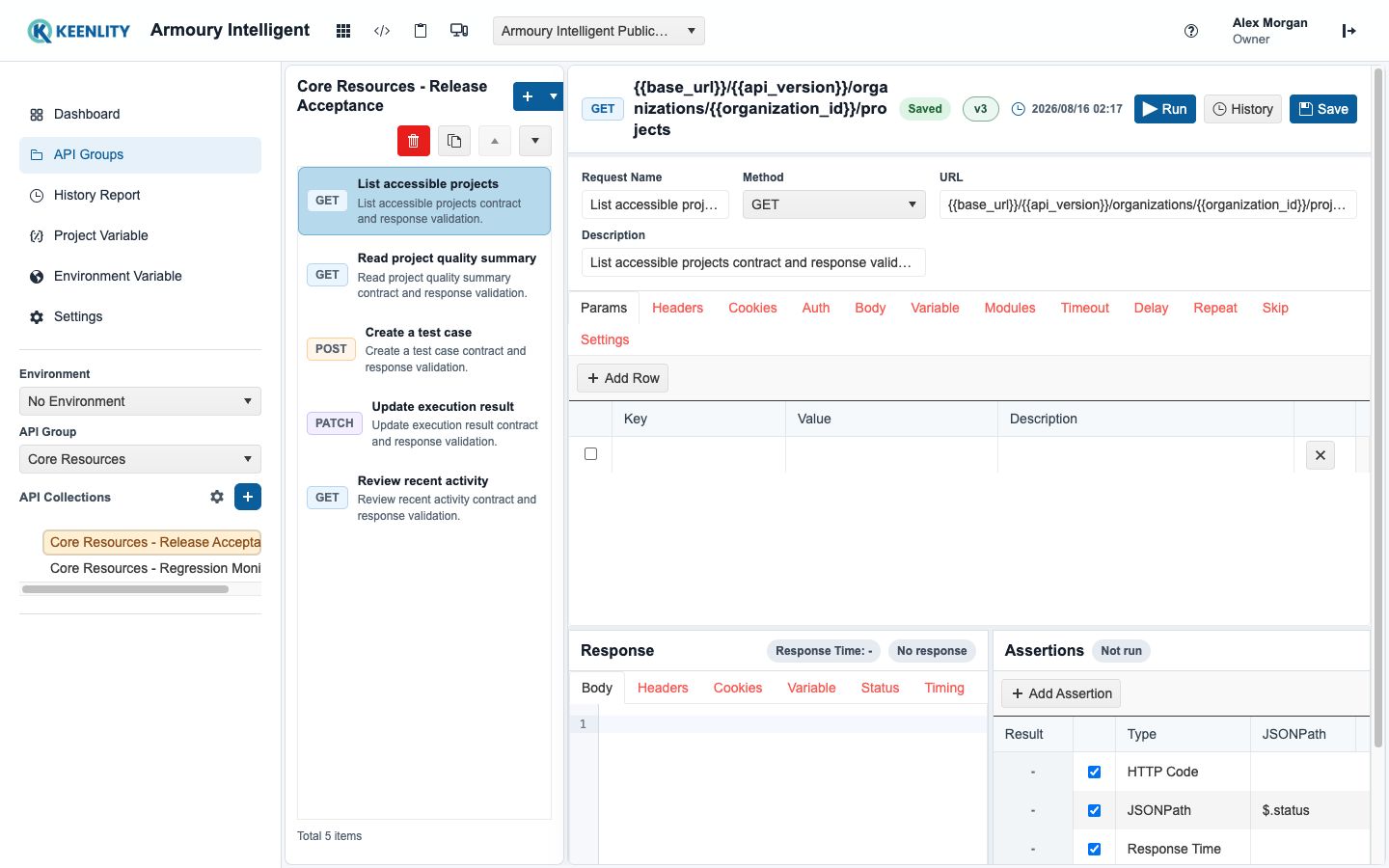
API Testing is a complete Armoury workspace, not a one-off request panel.
Stateful API validation
Keep request definitions, runtime state, assertions, configuration history, and retained HTTP evidence together so a result can be rerun and explained.
Use API Projects, Groups, physical or referenced Collections, nested flows, and ordered Requests to model real service behavior.
Resolve typed variables at project, environment, collection, and request scope, then use extractors and Save Variable assertions to chain calls.
Configure authentication, request bodies, transport options, HMAC, Hash, Timestamp modules, delays, repeats, conditional skips, and response assertions.
Inspect retained Request and Collection reports, configuration versions, HTTP evidence, and replay lineage, then compare or apply selected historical configuration.
From request chain to evidence
Build the sequence, resolve runtime values at the right scope, execute it in order, and investigate the saved report when behavior changes.
Create an API Project, organize Groups and nested Collections, and define the Requests in execution order.
Choose an Environment, resolve variables, generate runtime values, and validate status, timing, body, headers, cookies, or JSONPath.
Send one Request or execute a Collection, then inspect reports, HTTP exchanges, versions, and replay history.
Backend behavior you can explain
The saved definition, runtime inputs, ordered flow, assertions, and retained request and response evidence stay close enough to investigate a pass or failure. Coverage follows configured retention, redaction, and response-size limits.
Review plans and evaluation